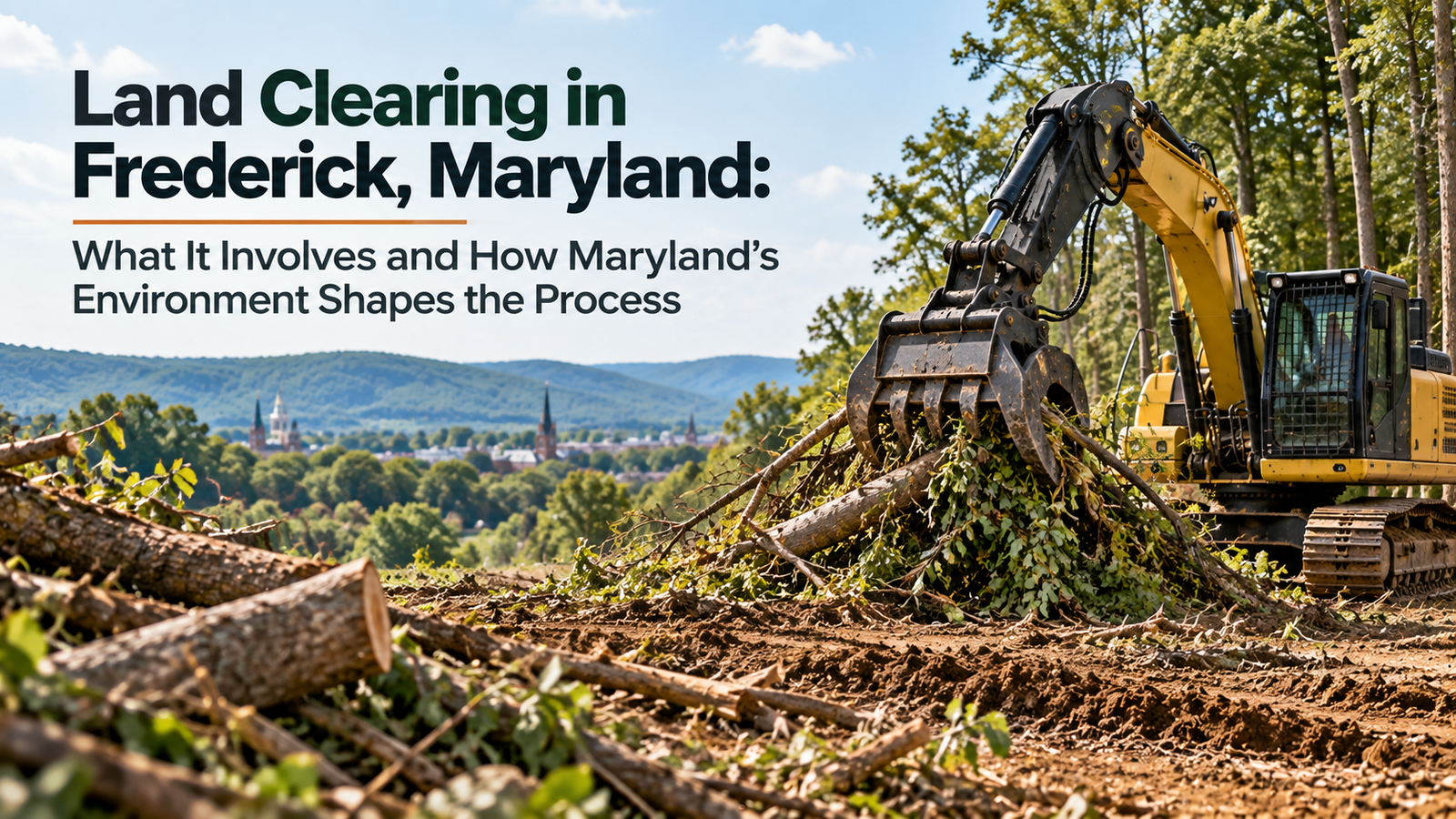

Land clearing in Frederick, Maryland is not simply a matter of cutting down trees and hauling away brush. In Maryland’s Chesapeake Bay watershed, every acre of cleared land that was previously forested or vegetated represents a change in how rainfall is managed, how sediment moves, and how the water quality of Frederick County’s streams and ultimately the Bay itself is affected. Maryland’s regulatory framework for land clearing reflects this environmental significance: clearing above certain thresholds requires approved sediment control plans, forest conservation compliance, and in some cases specific permits for removing trees near streams and wetlands. Understanding what Land Clearing Frederick involves both the physical work and the regulatory framework gives property owners the context they need to approach these projects correctly.
What Land Clearing Is and What It Covers
Land clearing encompasses the removal of trees, stumps, brush, shrubs, ground cover vegetation, and existing organic debris from a parcel or portion of a parcel in preparation for a defined end use. The end use construction, agriculture, pasture, landscaping, or simple access improvement determines the appropriate scope and depth of clearing and directly influences the regulatory requirements that apply.
In Frederick County and the City of Frederick, clearing occurs across a range of landscape types. Wooded parcels in the rural portions of the county often feature mixed hardwood forest dominated by oak, hickory, tulip poplar, and other eastern deciduous species, with understory layers of native shrubs and ground cover. These mature forest stands require significant equipment to clear effectively and generate large volumes of woody material that must be processed, burned (where burn permits allow), chipped, or hauled. Overgrown former agricultural fields that have been colonized by invasive species multiflora rose, autumn olive, and tree-of-heaven are common invasives throughout Frederick County represent a different clearing challenge that often requires both mechanical removal and follow-up chemical treatment to prevent rapid regrowth.
Forested stream buffers and wetland-adjacent areas require specific consideration during any Frederick land clearing project. Maryland’s Riparian Forest Buffer provisions and the Chesapeake Bay Critical Area regulations impose restrictions on clearing within defined buffers along streams and other waterways. Clearing within these protected buffers without appropriate authorization violates Maryland law and can result in significant fines and mandatory reforestation requirements.
Maryland’s Forest Conservation Act and Frederick County Compliance
One of the most significant regulatory considerations for land clearing in Frederick County is the Maryland Forest Conservation Act (FCA), which requires that any development project disturbing more than 40,000 square feet of land area address forest conservation as part of the permit process. The FCA requires applicants to: inventory existing forest on the site, identify forest retention priorities, minimize forest disturbance to the extent practical, plant trees to compensate for unavoidable forest removal, and in some cases pay into a forest mitigation fund when on-site planting is insufficient to meet conservation requirements.
Frederick County administers the FCA through its Department of Planning and Permitting. A Forest Stand Delineation (FSD) an inventory and assessment of existing forest cover on the site is required as part of development applications that trigger FCA review. The FSD informs the Forest Conservation Plan that establishes what forest will be retained, where new forest will be planted, and how the project meets the FCA’s net retention standards.
For smaller clearing projects below the FCA threshold the removal of several trees for a home addition, clearing of a small lot for an accessory structure, or agricultural clearing on an active farm the FCA may not apply but local grading and sediment control permits still govern the work. Frederick County’s Department of Permitting Services and the City of Frederick’s Planning Department both enforce the grading and sediment control requirements that apply to smaller clearing projects.
Sediment and Erosion Control for Frederick Land Clearing
Maryland’s sediment control regulations are among the most comprehensive in the nation, reflecting the state’s commitment to protecting Chesapeake Bay water quality. In Frederick County, any land disturbance exceeding 5,000 square feet or 100 cubic yards must have an approved Erosion and Sediment Control Plan. For most land clearing projects of any meaningful scale, this plan is required before clearing can begin.
The approved sediment control plan specifies the sequence of clearing, the locations and types of sediment control devices (silt fence, brush barriers, sediment traps, and sediment basins), the stabilization measures to be applied to cleared areas, and the maintenance and inspection protocols throughout the clearing period. Frederick County’s Soil Conservation District reviews these plans for larger projects; the City of Frederick’s Engineering Division reviews plans within the city limits.
Professional land clearing contractors in Frederick are familiar with these requirements and incorporate compliant sediment control practices into their project approach not as an afterthought but as an integrated part of how clearing work is sequenced and executed. Clearing without approved sediment controls exposes the property owner and the contractor to enforcement action, stop-work orders, and fines from both the state and the local jurisdiction.
The Physical Land Clearing Process in Frederick County
The specific methods and equipment used for land clearing in Frederick County depend on the vegetation density, tree sizes, site access, and the end use of the cleared land.
Forestry mulching using tracked machines equipped with rotating drum heads that shred trees, brush, and stumps into fine wood chip mulch is an increasingly popular clearing method for Frederick County sites where a moderate density of trees and brush needs to be cleared efficiently. The mulching machine processes everything in a single pass, leaving a layer of mulch on the ground that protects the soil from erosion, decomposes naturally, and in many cases provides adequate surface stabilization to satisfy sediment control requirements without additional measures. Forestry mulching is particularly well-suited to sites with significant invasive species that need to be eliminated, as the grinding process destroys the invasive plant material more completely than cutting alone.
Conventional clearing with chainsaws, skid steers, and bulldozers remains the standard approach for larger trees and higher-volume clearing work. Mature trees with trunk diameters above the practical range of forestry mulching heads are felled with chainsaws, processed into logs or chunks, and either sold as timber (if the species and size qualify), chipped for mulch, or hauled to disposal. Bulldozers push cleared material into piles for burning or grinding.
Stump removal after tree clearing is a critical step for sites where construction or agricultural use will follow. Stumps left in the ground decompose over years and decades, creating subsurface voids that can cause settlement problems for any structure built above them. Stump grinding reduces stumps to below grade, but the grinding residue wood chips and sawdust still decomposes in the soil. Complete stump removal by excavation is the most thorough approach for building footprints and other areas where subsurface void formation would be problematic.
Invasive Species and Frederick County’s Clearing Challenges
Frederick County like much of Maryland and the Mid-Atlantic region faces significant invasive plant species pressure that complicates land clearing work. Multiflora rose (Rosa multiflora), which forms impenetrable thorny thickets throughout the county, is one of the most common clearing challenges. Japanese knotweed, which grows rapidly along stream corridors and can re-establish from tiny root fragments left in the soil, requires specific protocols to prevent spread during clearing operations. Tree-of-heaven (Ailanthus altissima) is a prolific invasive tree species that sprouts vigorously from cut stumps and requires chemical treatment after mechanical removal to prevent regeneration.
Responsible land clearing in Frederick addresses invasive species in ways that prevent their spread to adjacent properties and cleared areas. This means using equipment cleaning protocols to prevent transporting invasive seed and root material from an infested site to a clean one, coordinating mechanical clearing with follow-up herbicide treatment where needed, and disposing of invasive plant material in ways that prevent its establishment elsewhere.
Common Questions About Land Clearing in Frederick
Does land clearing in Frederick County require any special permits? Yes, in most cases. The Erosion and Sediment Control Plan (for disturbances over 5,000 square feet or 100 cubic yards) is required in both the City of Frederick and Frederick County. The Maryland Forest Conservation Act applies to development projects disturbing over 40,000 square feet. Additional permits may be required for clearing near streams or wetlands. Contact Frederick County Department of Permitting Services or the City of Frederick Planning Department early in the project planning process to identify applicable requirements.
Can cleared trees and stumps be burned on site in Frederick County? Open burning in Maryland is regulated by the Maryland Department of the Environment. Agricultural burning is permitted under specific conditions in rural areas, but general debris burning may be restricted. Frederick County has specific local ordinances regarding burning. Confirm applicable burning restrictions with the local fire department and MDE before planning on-site burning as a debris management strategy.
How does land clearing affect property drainage in Frederick County? Removing vegetation significantly reduces the site’s ability to absorb rainfall through transpiration and soil infiltration, increasing surface runoff. Cleared sites can generate two to four times the runoff volume of forested sites. This increased runoff must be managed through the stormwater management infrastructure required by Frederick County’s development regulations, which is why stormwater planning is integrated into the clearing permit process.